


Intimate Artworks

Untitled/Portrait of Ross (1991)
This object is a piece of candy that was featured in Félix González-Torres’s art piece, “Untitled” (Portrait of Ross in L.A.). The art piece was created in 1991. The art piece featured a pile of multicolored pieces of candy. The dimensions of the pile would vary depending on where the piece was displayed, but the ideal weight would always stay the same at 175 pounds or 79 kg. While the art piece was displayed, the audience was encouraged to take a piece of candy from the pile, which would be replenished daily or sometimes twice a day. The art piece is located at the Art Institute of Chicago and is on view at Contemporary Art in Gallery 293. Félix created this art piece to honor his late partner, Ross Laycock, and to raise awareness about AIDS. The art piece’s weight represented Ross’s weight when he was alive, and the taking of the candy meant how AIDS chipped away at Ross until there was nothing of him left. Félix wanted to show Ross’s life in barebones, candid way by only visually describing him as an inhuman-like mass of candy.
Gonzalez-Torres, Felix. “‘Untitled’ (Portrait of Ross in L.A.).” The Art Institute of Chicago, January 1, 1991. http://www.artic.edu/artworks/152961/untitled-portrait-of-ross-in-l-a.
Frank Artworks

I am Out, Therefore I am (1989)
This object is a print of a crack-and-peel sticker made by Adam Rolson. The object features a hand holding a box stating, “I am out. Therefore, I am.” The object symbolizes the encouragement of being out and proud after the Stonewall Riots. The Stonewall riots were named after the Stonewall Inn, a popular gay bar. The riots were a response to a police raid on the bar, which sparked tension between the police and the gay community in New York City. The object is part of another exhibition called “REVIEW: ART AFTER STONEWALL, 1969-1989”, which was made by Tamas Vilaghy on January 25, 2021, and is currently on loan from the Grey Art Gallery in New York. The object’s art style is heavily based on Barbara Kruger’s art style and meaning. Barbara Kruger’s primary goal in her art was to explore methods of mass communication via the use of words in her art, as well as gender and identity.
Vilaghy, Tamas. “Review: Art after Stonewall, 1969-1989.” Caesura, January 29, 2021. https://caesuramag.org/posts/review-art-after-stonewall.


Safe Sex
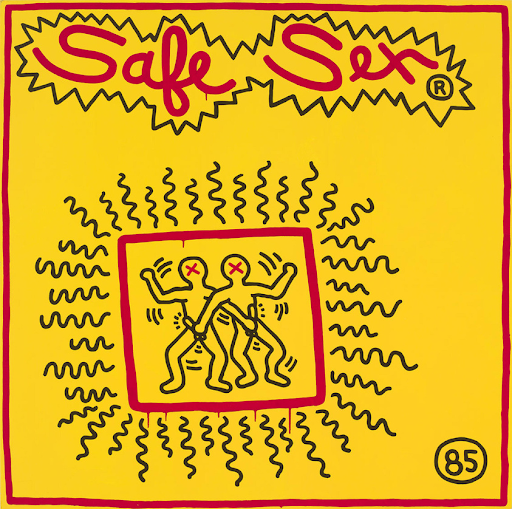
Keith Haring (1958-1990) was a prominent multimedia artist in the 1980s who achieved international recognition for his artwork and iconic style. He used his artwork to promote different political and social problems, such as the AIDS pandemic, which decimated the LGBT community in the 1980s and 1990s. Haring passed away in February 1990 due to HIV/AIDS-related complications at the age of 31. Before his death, Haring created multiple pieces related to the concept of “Safe Sex.” Haring’s artwork promoted safe sex with different characters having intercourse, engaging in various types of intercourse, and even a personified penis holding a condom along with the phrase SAFE SEX written above mentioned images. The central painting being highlighted is an acrylic artwork on canvas that is 120x120 inches, promoting frankness as the sheer size of the artwork grabs the audience’s attention. This type of artwork is under frank candidacy as Haring’s direct approach with the phrase “SAFE SEX” being on multiple types of artwork with imagery of figures with penises performing different kinds of sexual conduct is very forward, with the intended message as pro-condom usage for LGBT intercourse. Nicole Vitellone’s book Object Matters: Condoms, Adolescence and Time focuses on how “the discourse of safer sex initiates specific modes of regulation which concern the condom itself.” (Vitellone 2) In the book, Vitellone discusses the usage of “eroticized images of safer sex,” just like Haring’s 1985 artwork (Vitellone 78). His artwork was produced in the historical context of national public health movements led by the LGBT community through the promotion of condoms and emphasis on being safe during intercourse as opposed to abstinence. These movements were refuted by the Catholic Church in New York, which believed that condoms were against Christian morals. As seen in the documentary How to Survive a Plague, New York City’s 1989 archbishop, John Cardinal O’Connor, said, “The use of prophylactics is immoral in a pluralistic society or any other society.” (How to Survive a Plague) Haring’s use of figures having intercourse with the phrase above saying “SAFE SEX” not only combats the abstinence for LGBT but also combats the anti-condom rhetoric of the Catholic Church at the time.
Haring, Keith. SAFE SEX! 1987, Swann Auction Galleries, https://catalogue.swanngalleries.com/Lots/auction-lot/KEITH-HARING-%281958-1990%29-SAFE-SEX?saleno=2578&lotNo=200&refNo=780212
Haring, Keith. Safe Sex. 1985, Whitney Museum of American Art, https://whitney.org/collection/works/37778
Haring, Keith. SAFE SEX. 1985, The Keith Haring Foundation, https://www.haring.com/!/art-work/604-2
“How to Survive a Plague.” directed by David France. , produced by David France et al., Ro*Co Films, 2012. Alexander Street, https://video.alexanderstreet.com/watch/how-to-survive-a-plague.
Vitellone, Nicole. Object Matters: Condoms, Adolescence, and Time. Manchester University Press, 2008. https://ebookcentral.proquest.com/lib/agnesscott/reader.action?docID=1069590&ppg=1. Accessed Nov. 2023.


24h
60m
60s