

Intimate Photography
Yogo Putting on Her Powder
This picture from 1992 is titled Yogo Putting on Her Powder. Nan Goldin, the photographer who took this, was in Bangkok to capture the drag scene. Yogo is one of the many queens she took pictures of, all following the same theme of candidness. This picture specifically shows the in-between transformation of gender performativity, showing the candidness of someone caught in the action of doing something private. This picture is letting us in on the routine that Yogo goes through. Only her face is transformed into her drag counterpart, and one can only wonder if that was intentional for the picture. The photographer, Nan Goldin, is known for her work in the queer community, capturing the raw feeling of every moment. The candid nature of her photos is vital, which is essential to show a community of people who were taught to think they didn't belong.
Citation:
Goldin, Nan. Yogo Putting on Her Powder. n.d. MutualArt. https://www.mutualart.com/Artwork/Yogo-putting-on-her-powder--Bangkok/92BDB072B44E030D2BA2A7A9564A0F52.


Photo of Stonewall Riots
This object is a photograph of a celebration outside Stonewall Inn after the riots. The Stonewall riots were named after the Stonewall Inn, a popular gay bar. The riots were a response to a police raid on the bar, which sparked tension between the police and the gay community in New York City. While the Stonewall Riots were the most famous, there were several other uprisings due to club raids that came before. One of these raids was the Pepper Hill Club raid in Baltimore, Maryland, in 1985, where over 162 people were arrested. A chalk-written message on the wall in this photo states, “To fight for our country, they invaded our rights.” This photograph and many others were taken by Fred W. McDarrah, an American photographer who documented the Stonewall riots through pictures. This photograph was featured in his book, “Gay Pride, Photographs from Stonewall to Today”, which featured this and many other photographs taken of the Stonewall riots.
McDarrah, Fred W, and Timothy S McDarrah. Gay Pride: Photographs from Stonewall to Today. Chicago, Illinois: Chicago Review Press, 1994.
“Evening Star. [Volume] (Washington, D.C.) 1854-1972, October 03, 1955, Page B-3, Image 28.” News about Chronicling America RSS. Accessed December 2, 2023. https://chroniclingamerica.loc.gov/lccn/sn83045462/1955-10-03/ed-1/seq-28/#date1=1955&index=1&date2=1963&words=Club+Hill+Pepper&searchType=basic&sequence=0&state=&rows=20&proxtext=%22pepper+hill+club%22&y=8&x=12&dateFilterType=yearRange&page=1.
“Research Guides: LGBTQIA+ Studies: A Resource Guide: 1969: The Stonewall Uprising.” 1969: The Stonewall Uprising - LGBTQIA+ Studies: A Resource Guide - Research Guides at Library of Congress. Accessed December 2, 2023. https://guides.loc.gov/lgbtq-studies/stonewall-era.
Photo of Adrienne Rich
Adrienne Rich is an American poet, feminist, and essayist; she was born in 1929 in Maryland and studied at Radcliff. In Her famous essay, Compulsory Heterosexuality and the Lesbian Existence, Rich examines the erasure of lesbian existence, how heteronormativity impacts women, and introduces the lesbian continuum. Above is a candid shot of Adrienne Rich sitting at her desk, writing, and editing; this image lets viewers get a behind-the-scenes look at Rich's writing process and writing space. Rich uses her writing to voice her radical takes on motherhood, womanhood, and lesbianism. Rich argues that you do not have to be attracted to women to be a lesbian; Rich describes the act of decentering men as part of the lesbian continuum and that everyone in a patriarchal society is impacted by compulsory heterosexuality (632). Compulsory heterosexuality is a factor that erases lesbian existence. Thus, Rich proposes the lesbian continuum as an act of resistance. Rich herself is a lesbian, and she uses her positionality to further people's understanding of the feminist movement through a lesbian lens, which decenters men.
Adrienne Rich. Photograph. Lesbian Herstory Archives. April, 1979. https://dcmny.org/do/f13794f5-7ecf-40ee-a817-dfde878406cd
Rich, Adrienne. “Compulsory Heterosexuality and Lesbian Existence” Signs , Summer, 1980, Vol. 5, No. 4, Women: Sex and Sexuality (Summer, 1980), pp. 631-660. https://www.jstor.org/stable/3173834


Domestic
Artist Catherine Opie did this collection of photographs. Catherine Opie’s work came to fruition in the 90’s and onward, with her primary work being produced in photography, specifically film. The Domestic Collection (1995-1998) focuses on humanizing marginalized communities by portraying photographs of lesbian couples and families in their homes/comfortable environments. The details of her pieces are intentional in a way to convey the simplistic domestic life of society as a whole. This is important to the telling of the LGBT community as it shows the queer community in a home setting and just existing. The queer community is just living life. This piece is part of the intimacy side of candidacy as audiences of the collection get an insight into different homes of the queer community in the 1990s when the LGBT lifestyle was not normalized yet.
“Catherine Opie - Exhibitions - Regen Projects,” n.d., https://www.regenprojects.com/exhibitions/catherine-opie3/selected-works?view=multiple-sliders.
Frank Photography
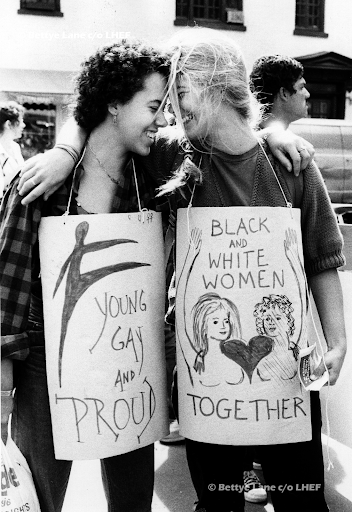
Black and White Women Together
On September 19, 1984, this picture of two unnamed lesbian women was taken at the International Gay and Lesbian March by photographer Bettye Lane. This was the fifth annual International Gay and Lesbian March, the first in 1979. The two pictured came to this march to show their pride in being lesbians, so much so that they posed for the camera. With their arms wrapped around each other, there is a message of solidarity between the black and white gay community. This type of message was rare but essential in the fight for equality of black people and the LGBTQ community. Queer of Color Critique, a term coined by Rodrick A. Ferguson, introduces the problems of racism and heterocentrism that were taking up space in the queer and black communities, respectively. This was a turning point in queer history because there was a change for voices with different perspectives that challenged the existing norms in the queer community.
Lane, Bettye. Black and White Women Together. n.d. Digital Culture of Metropolitan New York. https://dcmny.org/do/9098ae8d-75af-4898-9c7f-bc3ca2cf5119.
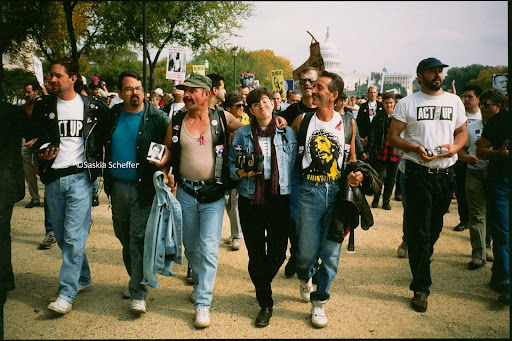
Act Up Ashes Action
During the AIDS epidemic, activists from groups such as Act Up organized bold actions to show the public the horrors of AIDS. The photograph above shows Acts Up Activists in Washington, D.C, on October 11th, 1992, as they are headed to the White House lawn to throw the ashes of their deceased loved ones who have passed from AIDS. This photo was archived in the Lesbian Herstory Archives, with the description, "Alexis and friends carrying their loved one's ashes to the White House." This photo shows the radical love, passion, creativity, and perseverance these activists embodied during the AIDS crisis. Activists are shown wearing Act Up t-shirts and silence death pins, with arms around each other. This radical Act of queer resistance, throwing ashes on the White House lawn, was an incredibly moving and impactful form of protest to the government's response to the Aids Crisis. This photo was candidly taken (photographer This photo was candidly taken (photographer unknown) during the Act Up Action, called A Political Funeral, and archived by Saskia Scheffer.
Scheffer, Saskia. Act Up Ashes action. Photograph. Lesbian Herstory Archives. October 11th, 1992. https://dcmny.org/do/71879e3b-eaef-4427-ae2c-721d9f73e93b


24h
60m
60s